PandaDoc Pricing 2026: What You Actually Pay
When you first start looking for a way to get a contract signed, PandaDoc pricing often looks inviting. They have a free plan, a set of professional tiers, and a feature list that makes it feel like they have every possible base covered. But for a freelancer, a small studio owner, or an independent landlord, the gap between “what the plan says” and “how it actually works” can be a frustrating place to land.
The reality is that most e-signature platforms are built for enterprise teams - companies that send hundreds of documents a month and have a dedicated procurement budget. For those people, a monthly subscription is just a line item. But for the rest of us, the friction isn’t just the monthly cost; it’s the mismatch between a recurring commitment and a one-time need.
Breaking Down the PandaDoc Pricing Tiers
To understand where the friction lies, we have to look at the actual tiers. As of November 2026, PandaDoc operates primarily on a subscription model.
The Free Plan
PandaDoc offers a free plan that allows you to upload and send documents for e-signature. On the surface, it’s a great entry point. However, the limits are tight. You are generally limited to 5 documents per month. For some, that’s plenty. But for a growing business, those five slots disappear quickly. If you have a busy month where you onboard a few new clients and a couple of contractors, you can hit that wall before the second week of the month is over.
The Paid Tiers
Once you move past the free plan, you enter the world of annual commitments. The Starter plan is priced at $19 per user per month, billed annually. The Business plan jumps to $49 per user per month, also billed annually.
The key word here is “annually.” To get these rates, you aren’t paying $19 once; you’re committing to a yearly sum. For a small business, this creates a “subscription ghost” — a recurring charge on a credit card for a tool that might sit unused for three months of the year, only to be indispensable during a one-week hiring push in January.
The “Limit Wall”: A Real-World Example
Pricing tables are one thing; the actual experience of hitting a limit is another. Imagine you run a small development studio. You’ve been using a free plan because you only send a couple of contracts a year. Then, suddenly, business picks up.
In a single month, you hire two new team members and sign a new anchor client. That’s two employment contracts, two NDAs, and one Statement of Work (SOW). You’ve hit your five-document limit exactly. But then, another small project comes in, or you realize you need to send a separate NDA to a new subcontractor.
You try to send that sixth document, but the system stops you. You’ve hit the 5-documents-per-month cap. To fix it, you have to upgrade. But you don’t want a monthly plan for a tool you’ll barely use next month. You end up paying for a yearly plan — like the Starter plan at $19 per user per month, billed annually — just to get that one additional document signed today.
This is the friction of the enterprise model. It’s not that the software is bad; it’s that the pricing is designed for a different kind of user. It’s designed for the person who needs a “Contract Lifecycle Management” (CLM) system, not the person who just needs a signature so they can start work.
Who is PandaDoc Actually For?
It would be unfair to say that PandaDoc isn’t a powerful tool. It is. For companies sending high volumes of complex proposals, the platform is excellent. If you are a sales team with ten reps sending fifty proposals a week, the subscription model makes sense. You need the templates, the tracking, and the bulk management features.
But for the freelancer, the independent contractor, or the landlord, those features are often just “bloat.” You don’t need a full lifecycle management suite; you need a legally binding signature. You don’t need to manage a “pipeline” of documents; you have one PDF and one client who is waiting to sign it.
The Third Option: Pay-Per-Document
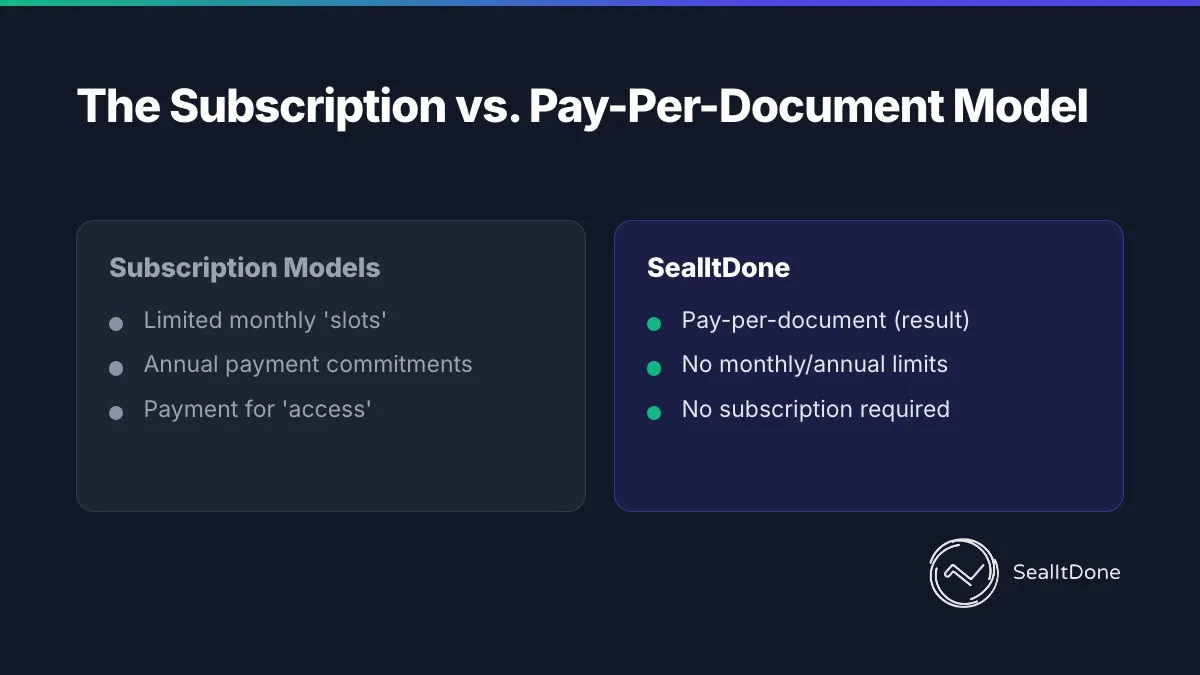
For a long time, the market has presented a binary choice: either use a restricted free plan and hope you don’t hit the wall, or commit to a monthly or yearly subscription.
But there is a third way. Instead of paying for “access” to a tool, you can pay for the “result” — the signed document.
This is where a pay-per-document model changes the math. Instead of worrying about whether you have “slots” left this month or remembering to cancel a subscription before it renews in six months, you simply pay for the document you are sending.
For $2.99, you can send a document to as many signers as you need. There are no signer limits to worry about, no annual contracts to sign, and no “free trials” that require a credit card up front. You get the same professional result — a legally binding, ESIGN and UETA compliant signature with a full audit trail—without the administrative chore of managing a software subscription.
The Hidden Costs of a Subscription
When choosing between a subscription and a pay-per-document model, it helps to look at the friction that doesn’t appear on the pricing page:
- The Mental Overhead: With a subscription, you’re always tracking your usage. “Do I have enough envelopes left?” “When does this renew?”
- The Financial Mismatch: Paying for a yearly plan when you only use the tool ten times a year is a poor trade.
- The Setup Friction: Enterprise tools often require extensive onboarding. For a one-off contract, you don’t want a tutorial; you want an upload button.
The goal should always be to spend less time on the paperwork and more time on the work that actually generates revenue. Whether you’re a web designer in Austin or a landlord in Columbus, the priority is getting the agreement sealed so the project can start.
If you’re finding that PandaDoc alternatives are necessary because you’re tired of the subscription treadmill, the shift to pay-per-document is the logical move. It turns a recurring liability into a simple, one-time cost.
Final Thoughts on PandaDoc Pricing
PandaDoc is a great tool for the enterprise. But for the “little guy,” the pricing is often a hurdle rather than a help. The frustration isn’t about the dollar amount — it’s about the commitment.
You shouldn’t have to buy a whole year of software just to get one SOW signed on a Friday afternoon. You deserve a tool that fits the way you actually work: occasionally, urgently, and without the need for a PhD in subscription management.