Is Docusign Legally Binding? What the Law Says
You just got an email asking you to sign a contract through Docusign, or a client wants you to use it for your next agreement. Before you click “Sign,” you want to know one thing: is Docusign legally binding?
Generally, yes. A signature made through Docusign is legally binding in the US under the ESIGN Act and UETA, the same as one made on paper. But the reason has nothing to do with the brand. The law protects electronic signatures in general, and the same rules apply to every e-signature tool.
Is Docusign Legally Binding Under US Law?
Two laws do the work. The federal ESIGN Act says a signature or contract cannot be denied legal effect solely because it is in electronic form. At the state level, the Uniform Electronic Transactions Act (UETA) says the same thing. As of October 2026, Docusign’s own legality page notes that 49 states, Washington, D.C., Puerto Rico, and the U.S. Virgin Islands have enacted versions of UETA, and New York has a similar law of its own.
Both laws define an electronic signature very broadly: “an electronic sound, symbol, or process, attached to or logically associated with a contract or other record and executed or adopted by a person with the intent to sign the record” (15 U.S.C. § 7006).
Notice what that definition doesn’t mention: a specific company, a price, or a type of software. Clicking “Sign” in Docusign fits the definition. So does clicking “Sign” in any other tool that meets the same requirements.
What Makes a Docusign Signature Hold Up in Court
“Legally binding” and “impossible to challenge” aren’t the same thing. If someone disputes a signed agreement, the person relying on it has to show a few things. Docusign’s legality page summarizes them well. You need to be able to show that:
- The signer intended to sign. Clicking a clearly labeled “Sign” button counts.
- The signature belongs to that person. This is usually shown with the signer’s email address, IP address, and timestamps.
- The signature is attached to the document. It has to be linked to the specific record that was signed.
- The signer could keep a copy. Everyone should be able to download or receive the final document.
- The record wasn’t altered. The signed file has to be kept in a way that shows it hasn’t changed since signing.
Points 2 and 5 are where most disputes play out, and they come down to evidence. That’s why an audit trail matters more than the logo on the signing screen. For a deeper look at how courts weigh e-signatures, see our guide to whether an electronic signature is legally binding.
Is Docusign “More Legal” Than Cheaper Tools?
No. This is the most common misconception about e-signatures. ESIGN and UETA are technology-neutral. They don’t rank tools, and a court doesn’t give extra weight to a signature because it came from a well-known platform or a pricier plan.
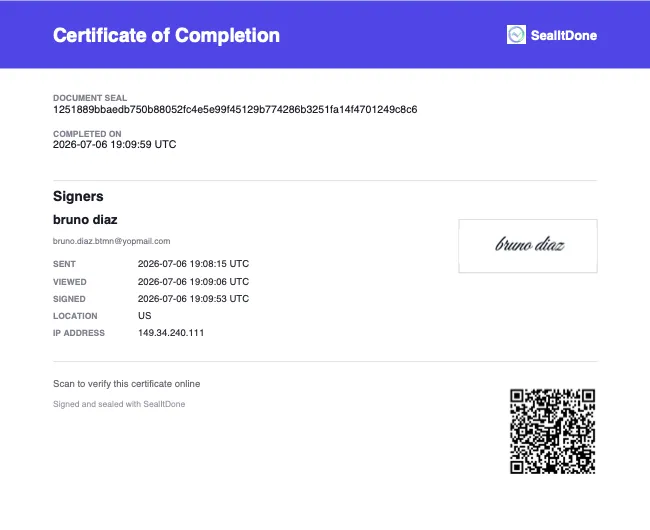
What a court looks at is the evidence. Any tool that captures intent, ties the signature to the signer, and keeps a tamper-evident record gives you the same legal footing. For example, SealItDone records each signer’s name, email address, IP address, and exact timestamps in an audit trail, and adds a QR code to the sealed document so anyone can verify it.
So the real choice isn’t about legality. It’s about cost and fit. If you sign a handful of documents a year, a monthly plan built for sales teams may be more than you need. Our Docusign alternative page compares the two approaches side by side.
When Any E-Signature May Not Be Enough
Docusign or not, some documents fall outside ESIGN. The law lists specific exceptions where other rules still apply, including:
- Wills, codicils, and testamentary trusts.
- Adoption, divorce, and other family law matters.
- Court orders and official court documents.
- Notices of utility shut-off, foreclosure, or eviction from a primary residence, and cancellation of health or life insurance.
For everyday business paperwork, such as service agreements, SOWs, NDAs, invoices, and leases, an e-signature is generally enforceable. This is general information, not legal advice. If you’re unsure about a specific document, check with a lawyer.
Got a Docusign Request? A Quick Safety Check
Because Docusign is so widely used, scammers sometimes impersonate it in phishing emails, as Docusign’s Safety Center warns. Before you sign anything, take ten seconds to check:
- Do you know the sender? You should be expecting a document from this person or company.
- Does the request make sense? An unexpected invoice or “account verification” request is a red flag.
- Never enter a password from an email link. If anything looks off, contact the sender directly using details you already have.
A legitimate signature request is legally binding. A fake one is just a scam. Knowing the difference protects you more than any law.
The Bottom Line
Is Docusign legally binding? Generally, yes, and so is any e-signature tool that follows ESIGN and UETA. The law cares about intent, attribution, and a reliable record, not the brand name or the monthly bill.
If you only need to send the occasional contract, you can get the same legal standing without a subscription. With SealItDone you pay per document, your signers don’t need an account, and every document comes with a full audit trail.